

Re-evaluating cloud chamber constraints on depositional ice growth in cirrus clouds
Authors
Kara Diane Lamb — Columbia University *
Jerry Y. Harrington — Pennsylvania State University
Marcus van Lier-Walqui — Columbia University
Category
Microphysics (cloud, aerosol and/or precipitation)
Description
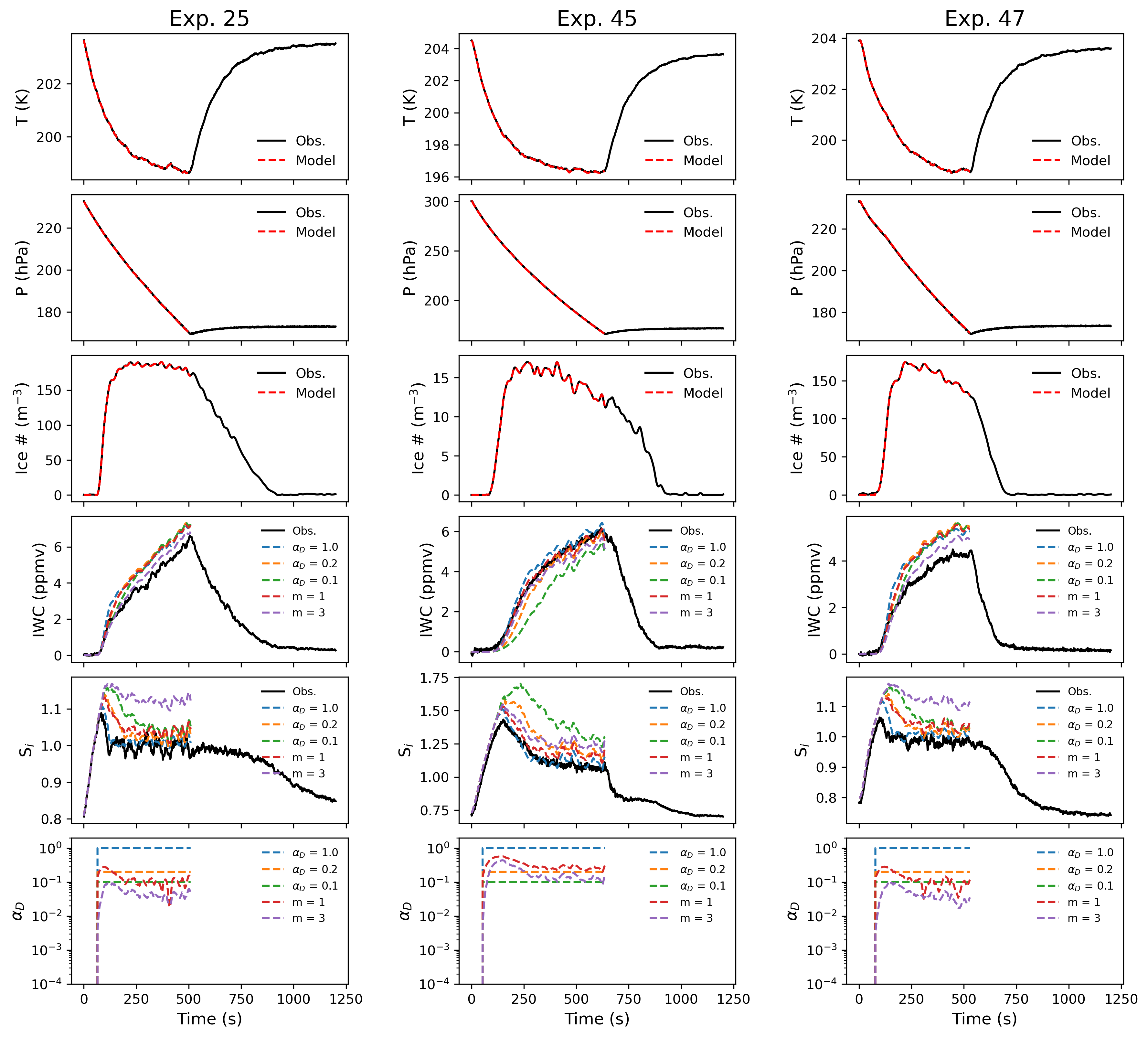
Ice growth from vapor deposition is an important process for the evolution of cirrus clouds, but the physics of depositional ice growth at the low temperatures (<235 K) characteristic of the upper troposphere/lower stratosphere is not well understood. Surface attachment kinetics, generally parameterized as a deposition coefficient alpha_D, are expected to limit growth rates in certain cases and control pristine ice crystal habit, but significant discrepancies between experimental measurements have not been satisfactorily explained. Experiments on single ice crystals have previously indicated the deposition coefficient is a function of temperature and supersaturation, consistent with growth mechanisms controlled by the crystal's surface characteristics. Observations of surface kinetic processes on faceted single crystalline ice have led to the development of the Diffusion Surface Kinetics Ice Crystal Evolution (DiSKICE) model, which approximates ice with two semi-axes to model crystal habits, allowing for different ice aspect ratios to be consistently modeled during depositional ice growth (Zhang and Harrington, 2014). Here we compare the DiSKICE model with observations from cloud chamber experiments simulating realistic cirrus conditions involving rapidly changing temperature, pressure, and ice supersaturation, so that depositional ice growth may evolve from diffusion-limited to surface kinetics-limited over the course of a single experiment. We compare the observed ice water content and saturation ratios to that derived under varying assumptions for ice surface growth mechanisms for experiments simulating ice clouds between 180 and 235 K and pressures between 150 and 300 hPa. We find that both heterogeneous and homogeneous nucleation experiments at higher temperatures could generally be modeled consistently with either a constant deposition coefficient or with the DiSKICE model assuming growth via abundant surface dislocations. Lower temperature experiments showed more significant deviations from any depositional growth model. To consistently treat experimental uncertainty in the chamber experiments, we use Bayesian parameter estimation to constrain parameters in the depositional ice growth model.
Lead PI
Kara Diane Lamb — Columbia University