
Cloud Regimes in the TWP and Their Evolution Over the MJO
Submitter
Del Genio, Anthony D. — National Aeronautics and Space Administration
Area of research
Cloud Distributions/Characterizations
Journal Reference
Chen, Y, and AD Del Genio. 2008. "Evaluation of tropical cloud regimes in observations and a general circulation model." Climate Dynamics doi:10.1007/s00382-008-0386-6.
Science
It has become popular to evaluate global climate models (GCMs) using “cloud regimes” that are ob
Impact
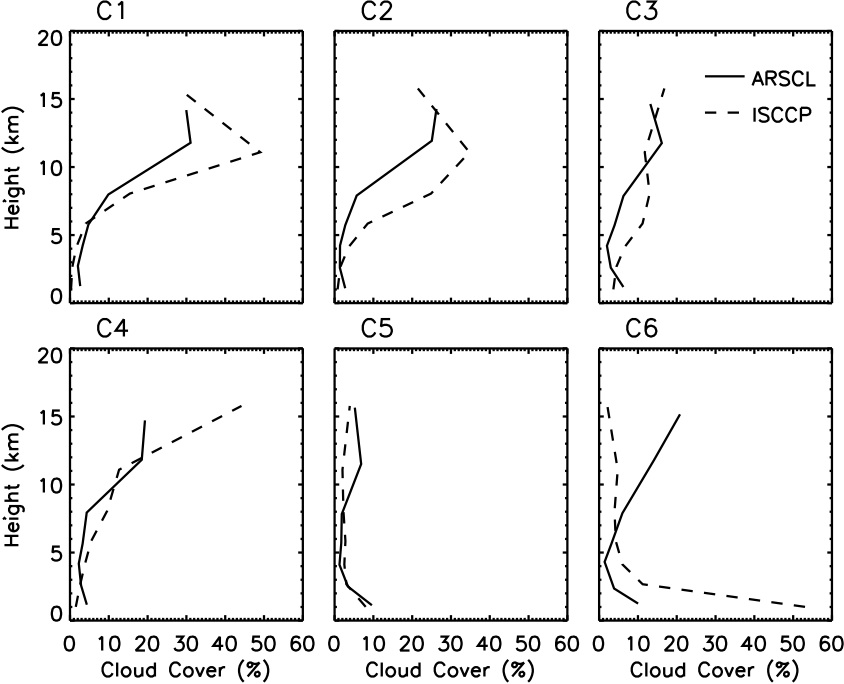
ISSCP’s passive remote sensing retrieval misses some thin clouds and sometimes places cloud top at the wrong altitude. Thus, before evaluating GCMs against ISCCP, it is necessary to assess the validity of the ISCCP clusters. We aggregated highest cloud top distributions from ARM ARSCL data at Manus and Nauru by coincident ISCCP cluster occurrence. Figure 1 shows that ISCCP overestimates midlevel and low level clouds in the anvil (C2) and congestus (C3) clusters. When ISCCP cloud top heights are adjusted to match ARSCL, the independence of several clusters disappears. Direct clustering of ARSCL profiles themselves produces only four independent regimes at Manus and three at Nauru.
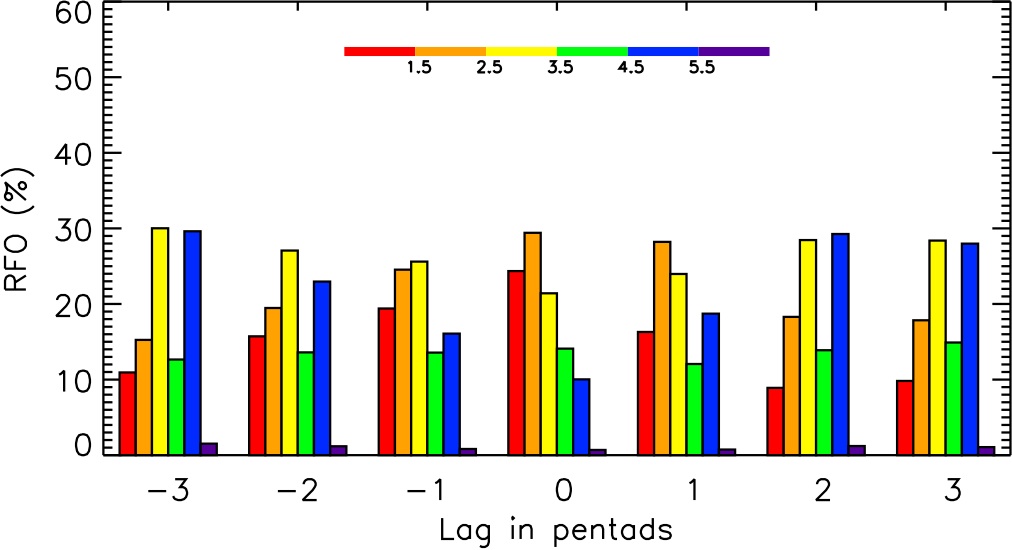
A different assessment approach is to determine whether clusters vary systematically with the large-scale dynamic state. We focus on the Madden-Julian Oscillation (MJO), the major mode of sub-seasonal variability in the Tropical Western Pacific (TWP). Figure 2 shows that in the suppressed phase of MJO, the ISCCP congestus and shallow cumulus clusters dominate, giving way near the peak to the deep convective and anvil clusters. This progression with phase is consistent with the recharge-discharge view of MJO evolution due to moisture preconditioning of the troposphere by shallow and midlevel clouds. The thin cirrus regime is insensitive to MJO phase, suggesting a non-convective origin. We conclude that the six ISCCP clusters probably do contain independent information, but represent neither a true distribution of all clouds nor a true distribution of highest cloud top heights.
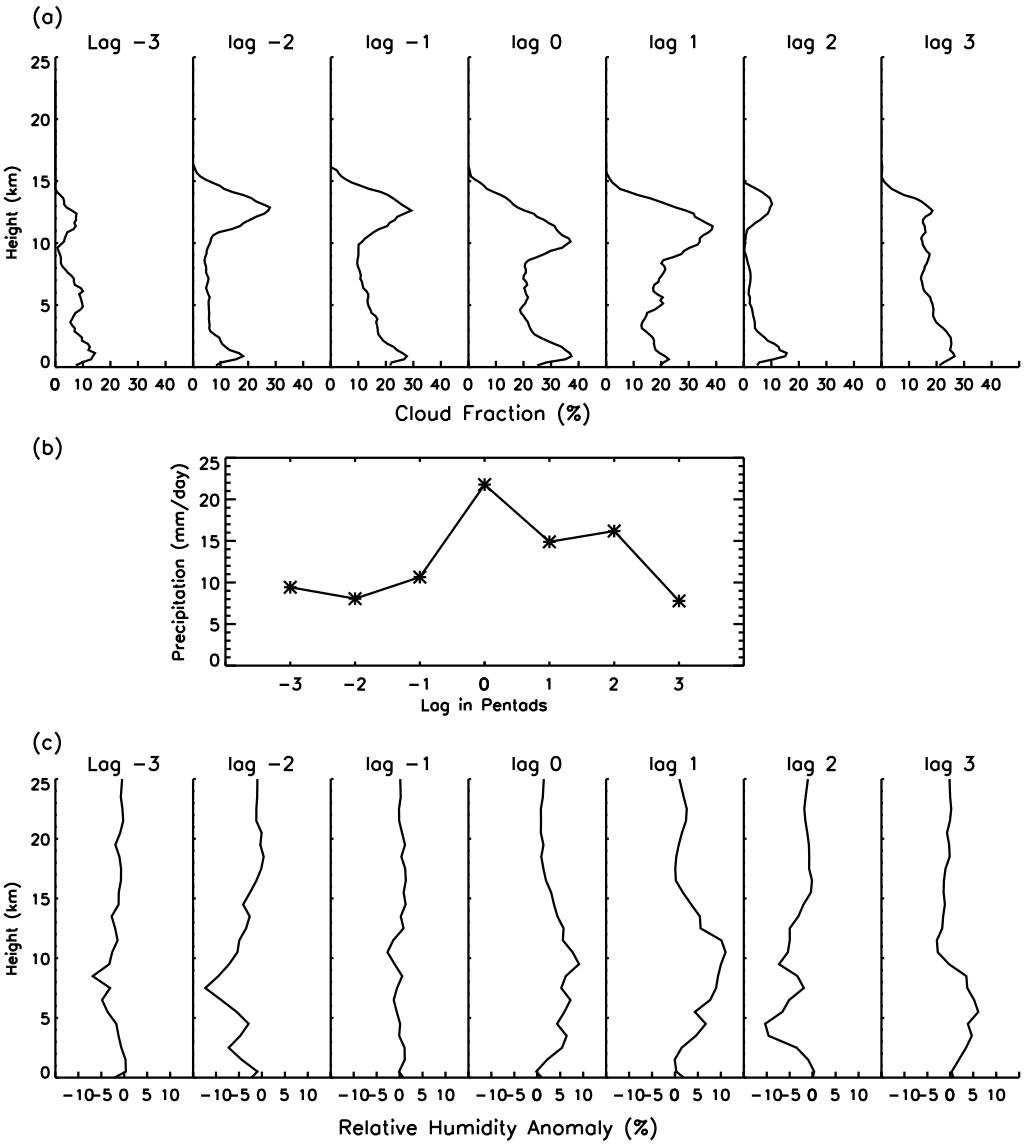
ARSCL cloud profiles at Manus aggregated by MJO phase support this view of the progression of cloud types (Figure 3). A trimodal distribution of clouds during the suppressed phase gives way to a bimodal distribution of deep and shallow clouds and increasing overall cloud cover as the peak approaches and precipitation maximizes. After the peak high clouds dominate, then give way again to a suppressed phase trimodal profile. Relative humidity profiles at Manus show dry conditions before MJO peak and humid conditions at and just after the peak.
Summary
The GISS Model E GCM produces only four clusters. These most closely resemble the deep convective, congestus, shallow cumulus, and stratocumulus regimes. However, closer inspection reveals that the GCM in fact rarely produces midlevel congestus, and shallow convection occurs almost equally often in the two suppressed regimes. This indicates that clustering on cloud properties does not accurately reflect the parameterized physical processes operating in the model.