

Boundary layer moisture at the Eastern North Atlantic Atmospheric Observatory during marine conditions
Authors
Maria Paola Cadeddu — Argonne National Laboratory *
Virendra Prakash Ghate — Argonne National Laboratory
David D. Turner — NOAA Global Systems Laboratory
Thomas Surleta — Argonne National Laboratory
Category
Boundary layer structure, including land-atmosphere interactions and turbulence
Description
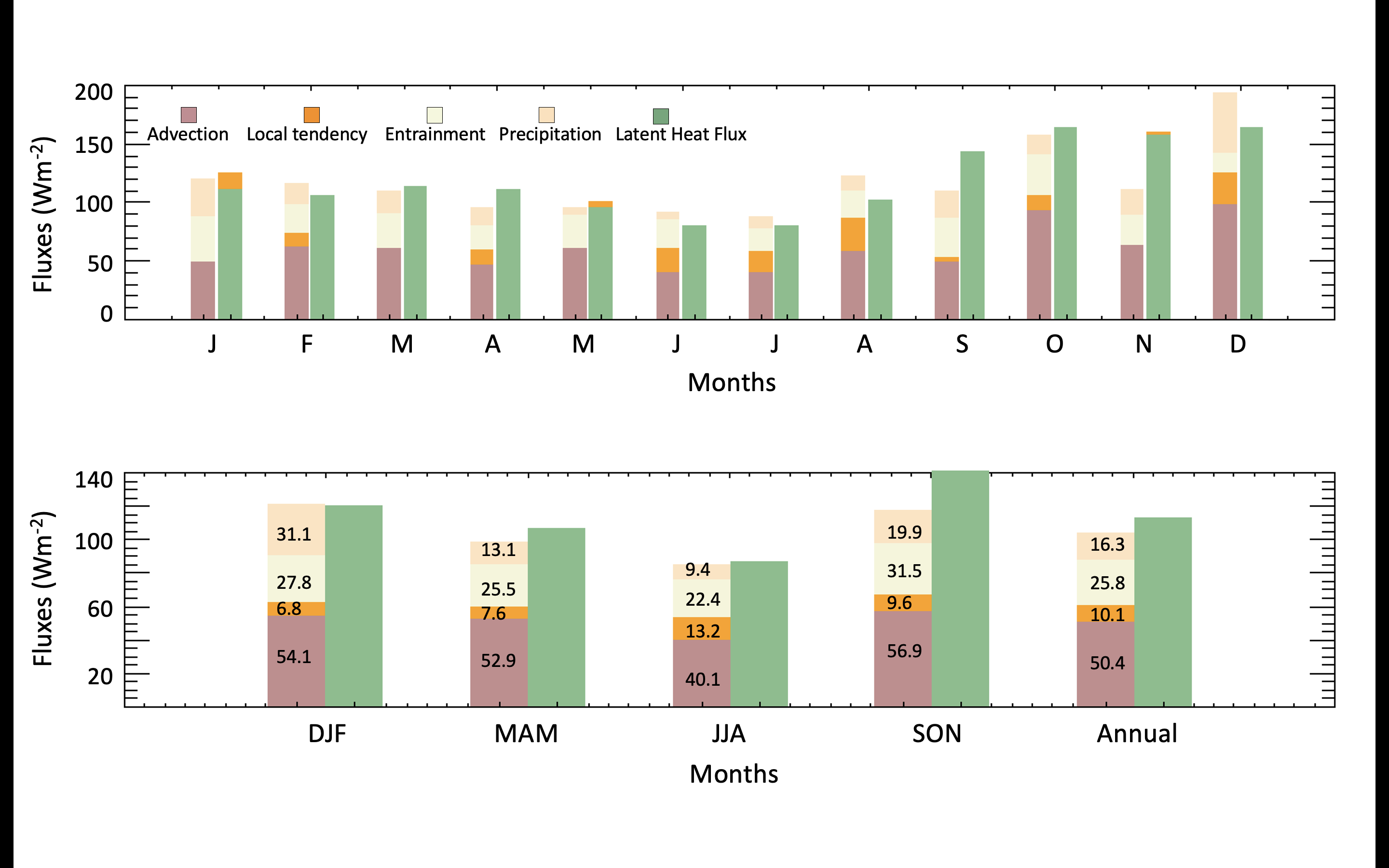
Boundary layer moisture variability at the Eastern North Atlantic (ENA) site is examined at monthly and daily time scales using 5 years of ground-based observations and output from European Center for Medium range Weather Forecast (ECMWF) reanalysis model. A special effort is devoted to an analysis of the climatology of precipitable water vapor (PWV), cloud, and drizzle liquid water path (LWP) derived from the 3-channel microwave radiometer (MWR3C) at the site. The annual cycle of the mixed layer water budgets shows the relative contribution of large-scale advection, local moisture tendency, entrainment, and precipitation to balance the moistening due to surface latent heat flux on monthly timescales. Advection of colder and dry air from the North acts as an important moisture sink (~ 50% of the overall budget) during fall and winter driving the seasonality of the budget. Entrainment and precipitation contribute to the drying of the boundary layer (~25% and ~15% respectively) and the local change in moisture contributes to a small residual part.
On a daily temporal scale, moist and dry mesoscale columns of vapor (~10 km) are analyzed during 10 selected days of precipitating stratocumulus clouds. Adjacent moist and dry columns present distinct mesoscale features that are strongly correlated with clouds and precipitation. Dry columns adjacent to moist columns have more frequent and stronger downdrafts immediately below the cloud base. Moist columns have more frequent updrafts, stronger cloud top cooling, higher liquid water path and precipitation compared to the dry columns. These observations point towards the existence of a subsidence region of increased turbulence in the sub-cloud layer of the dry patches where dry air may be entrained and eventually mixed in the boundary layer, eventually reinforcing the drying. On the other end there may be a reinforcing of the moistening in the moist columns through the lower troposphere and the lifting up of moist air in the sub-cloud layer. This study highlights the complex interaction between large-scale and local processes controlling the boundary layer moisture and the importance of vapor spatial distribution to support convection and precipitation.
Lead PI
Maria Paola Cadeddu — Argonne National Laboratory