

Cloud morphology in simulated marine cold-air outbreaks over the Norwegian Sea during COMBLE: sensitivity to aerosol treatment and ice production
Authors
Florian Tornow — Columbia University/NASA Goddard Institute for Space Studies *
Ann M. Fridlind — Goddard Institute for Space Studies
Abigail Williams — Scripps Institution of Oceanography
Lynn M Russell — Scripps Institution of Oceanography
Jeramy L Dedrick — University of California San Diego
Andrew Ackerman — NASA - Goddard Institute for Space Studies
Israel Silber — Pacific Northwest National Laboratory
Timothy Juliano — NSF National Center for Atmospheric Research
Category
High-latitude clouds and aerosols
Description
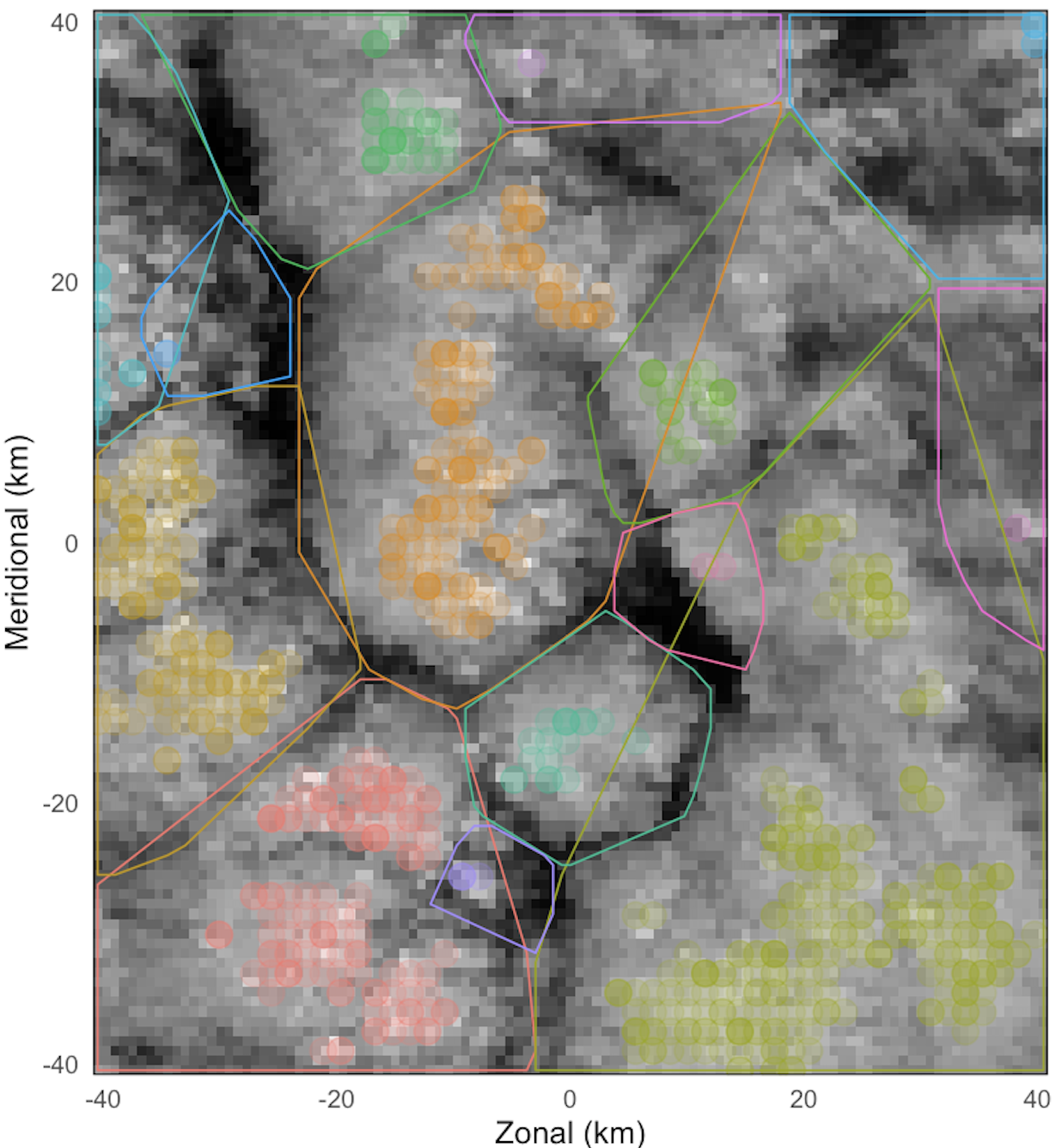
Low-level clouds typically reflect solar radiation efficiently. Aside from other cloud properties, cloud morphology influences the magnitude of reflection on a large scale. Marine cold-air outbreaks (MCAOs) produce a wealth of morphologies: MCAOs typically form boundary layer (BL) clouds organized as rolls that fill in to become a near-overcast cloud deck composed of closed cells that lastly transition to either an open-cellular deck following the onset of substantial precipitation or to a deck composed of cells that grow in size and distance to one another as the BL deepens, distinguished by a more gradual evolution in cloud albedo with fetch in the latter type. During the COMBLE campaign, many MCAOs were observed over the Norwegian Sea that provide a panoply of cloud morphological transitions. We selected five cases that can roughly be grouped into three distinct types. Using visible imagery from polar-orbiting satellite platforms, we examine the evolution of morphology with fetch. Here we describe morphology as a collection of cloudy cells of ranging cell size and apply a novel cloud clustering technique to imagery. We compare against Lagrangian large-eddy simulations (LES) by applying the clustering technique to pseudo-albedo fields. A range of sensitivity experiments allows us to assess how morphology is impacted by (1) the treatment of aerosol, either set up diagnostically or prognostically and informed by upwind ground observations at the Zeppelin site on Svalbard, Norway, and by (2) modifications to primary and secondary ice production. Lastly, we use LES three-dimensional output to extract vertical information of aerosol and hydrometeors, as well as dynamical and thermodynamical fields of each cluster to investigate morphology-shaping mechanisms. Downwind measurements from the 2020 ARM mobile facility (AMF) deployment to Andenes, Norway, enable us to evaluate the realism of the post-transition cloud field and assess the above profiles.
Lead PI
Ann M. Fridlind — Goddard Institute for Space Studies