

Subcloud convergence lines: properties and implications on deep-convection initiation
Submitter
Kirshbaum, Daniel — McGill University
Area of research
Vertical Velocity
Journal Reference
Science
Boundary-layer convergence lines (CLs) and their associated subcloud updrafts are responsible for many, if not most, deep-convection initiation events in the continental USA. To quantify the morphology and strength of CLs, and to compare them to ordinary turbulent circulations in the boundary layer, we develop two methods of CL quantification using available data at the SGP observatory. Using six years of data including dozens of CLs, it is found that CLs are only marginally stronger and wider than ordinary turbulent thermals.
Impact
A highlight of this work is the development of two methods to quantify CL properties, one primarily based on radar and the other primarily based on surface meteorological observations. The latter method facilitates CL analysis in locations lacking the unique observational assets at ARM climate research facilities. Moreover, the scientific findings obtained herein direct research on deep-convection initiation to identifying important factors beyond subcloud updraft width and strength.
Summary
Deep convection is commonly initiated by boundary-layer convergence lines (CLs), which are associated with intense surface-based wind convergence and strong updrafts that may lift air to saturation. Although CLs form regularly, they are far less common than ordinary, short-lived turbulent thermals in the daytime boundary layer. To better understand why CLs are so effective at deep-convection initiation, we observationally quantify their morphologies and strengths and compare these properties to those of surrounding turbulent updrafts. Perhaps surprisingly, the CLs are found to exhibit only slightly larger scales and strengths than the turbulent updrafts. Although these marginal increases help to explain the preference for storms to initiate along CLs, they likely are not the whole story.
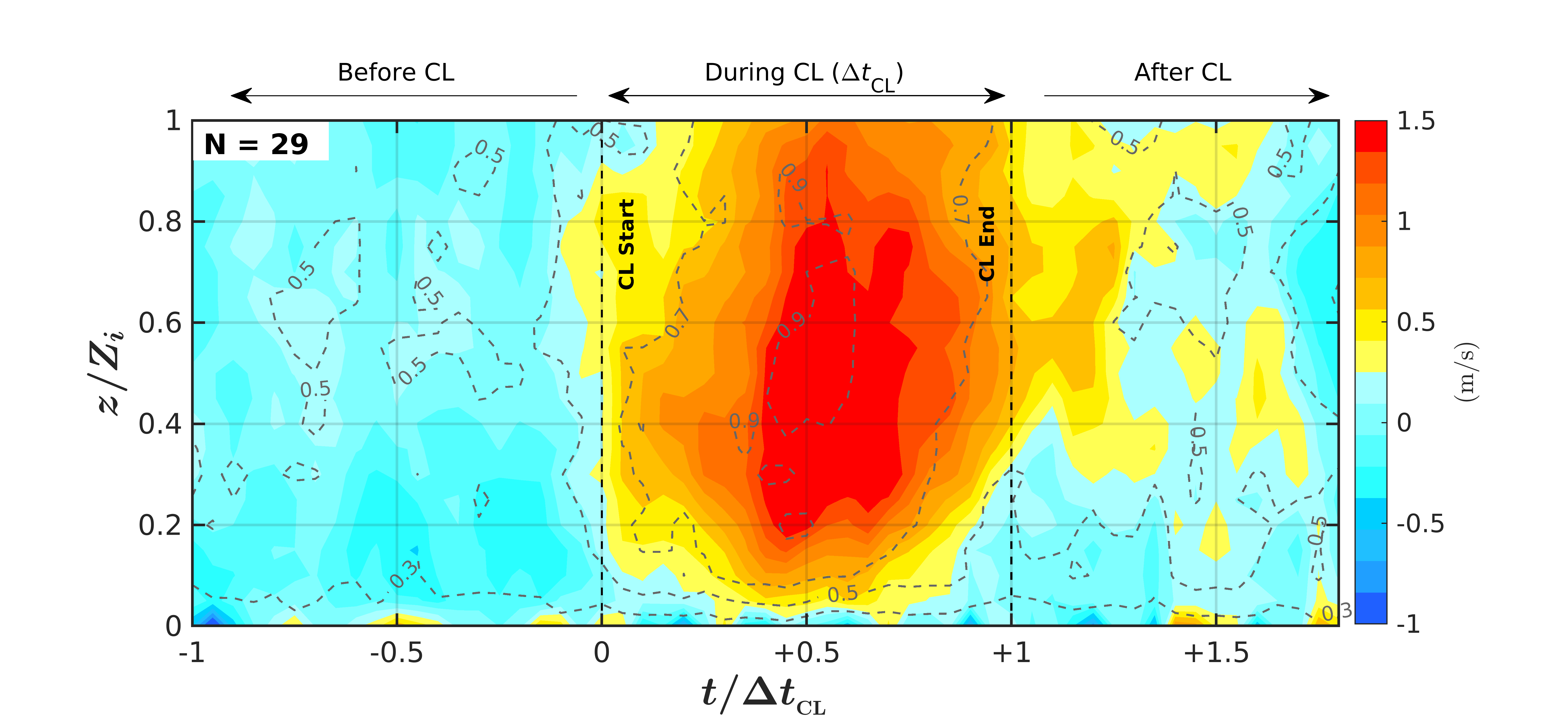
Figure 1. Composite mean vertical motion (filled) and updraft fraction (dashed contours) for 29 daytime SGP CLs observed by the ARM Doppler lidar. Time is normalized by the CL duration and height is normalized by the PBL depth (Z_i). Note the rearward tilt of the updraft over the denser air following CL passage. Image from journal.
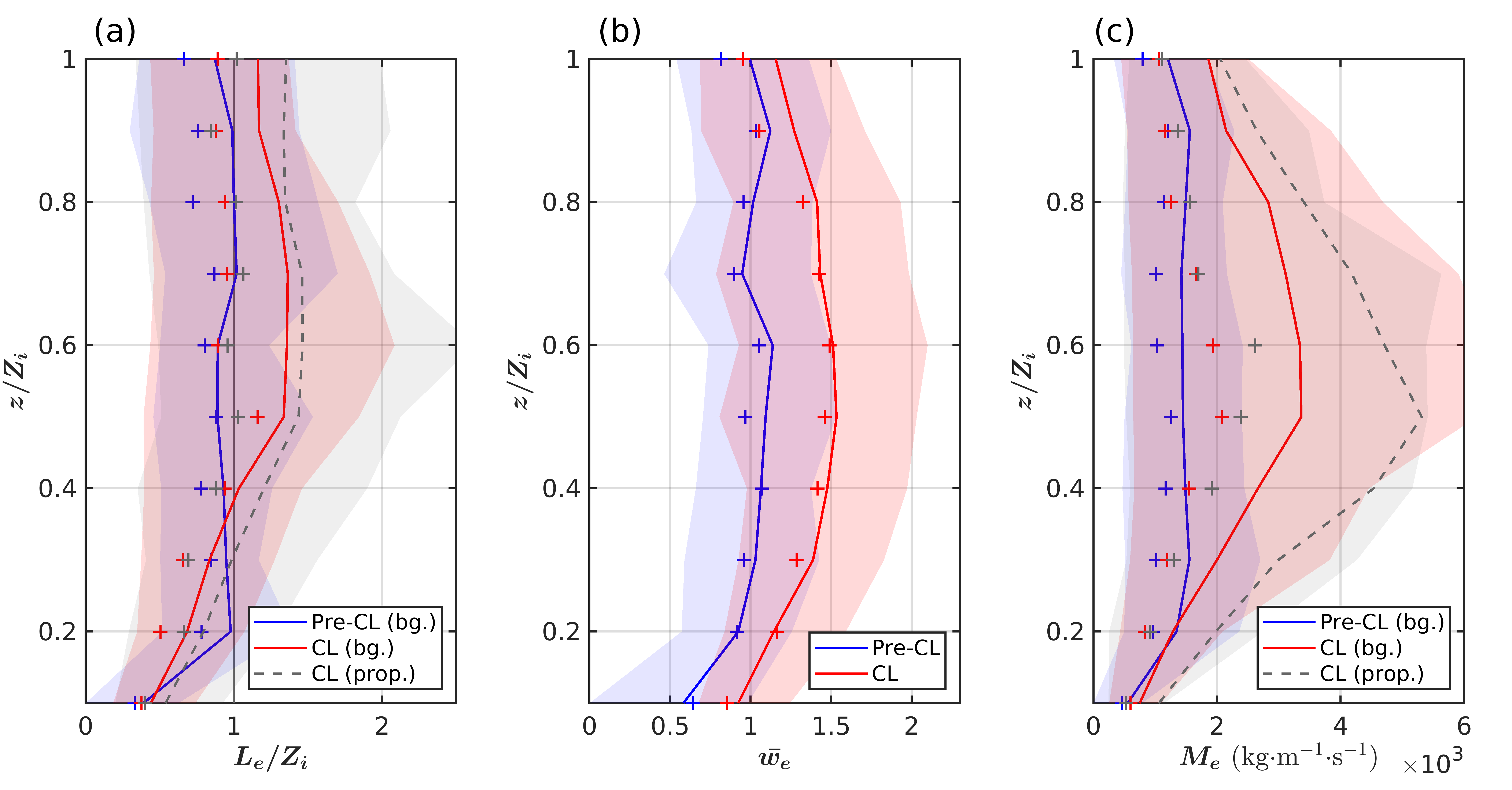
Figure 2. Composite mean profiles of the widest connected updraft properties for daytime SGP CLs and the largest turbulent thermal in the 30 min preceding each CL (the "pre-CL" period). Updraft (a) width (L_e), (b) mean vertical velocity (w_e), and (c) vertical mass flux (M_e) of the widest connected updraft. Note that CL updrafts are only about 20-30% stronger and wider than turbulent pre-CL updrafts. Image from journal.