

Musings on mixing state
Submitter
Riemer, Nicole — University of Illinois Urbana-Champaign
West, Matthew — University of Illinois at Urbana-Champaign
Area of research
Aerosol Properties
Journal Reference
Science
This editorial lays out some fundamentals for how to think about the aerosol state and explores implications of the emergent aerosol property called aerosol mixing state.
Impact
We are now at a point where single-particle data are becoming more and more available, where compute power is sufficient to run mixing-state-aware models, and where new analytical techniques, including machine learning, offer the possibility of processing large amounts of high-dimensional, single-particle data to infer population-level properties and processes. Now is the right time to reevaluate how we should be thinking about some of the basic questions in aerosol science to facilitate aerosol model representations and model-measurement comparisons—How should we describe the aerosol state? What are the implications for modeling and measuring aerosols? What does it take to meaningfully compare mixing state measurements with model results?
Summary
This editorial elucidates the fundamental properties of the aerosol state and the implications of the fact that atmospheric aerosols are mixtures of mixtures—each aerosol particle usually contains several chemical components, and particles of diverse composition are assembled within a population. A convenient way to conceptualize this fact is to think of the aerosol residing in a high-dimensional composition space. The implications can be summarized as follows:
- Common aerosol modeling approaches and aerosol measurement techniques work with low-dimensional projections of this high-dimensional space. As a result, information of the true aerosol state is lost.
- There are many different ways to obtain low-dimensional projections for use as aerosol model representations. This introduces structural and parametric uncertainties in our models that are still largely unquantified.
- Comparisons of mixing state predictions with observations are challenging. One of the main hurdles in this endeavor is to find a mapping between the quantities that the model tracks and the quantities that a given measurement technique provides. Only when such a mapping exists is a quantitative comparison possible.
- It is worth developing such mappings because it will allow for stronger constraints on our aerosol predictions, which are necessary to ensure that we obtain the right results for the right reasons in our predictions of aerosol climate impacts.
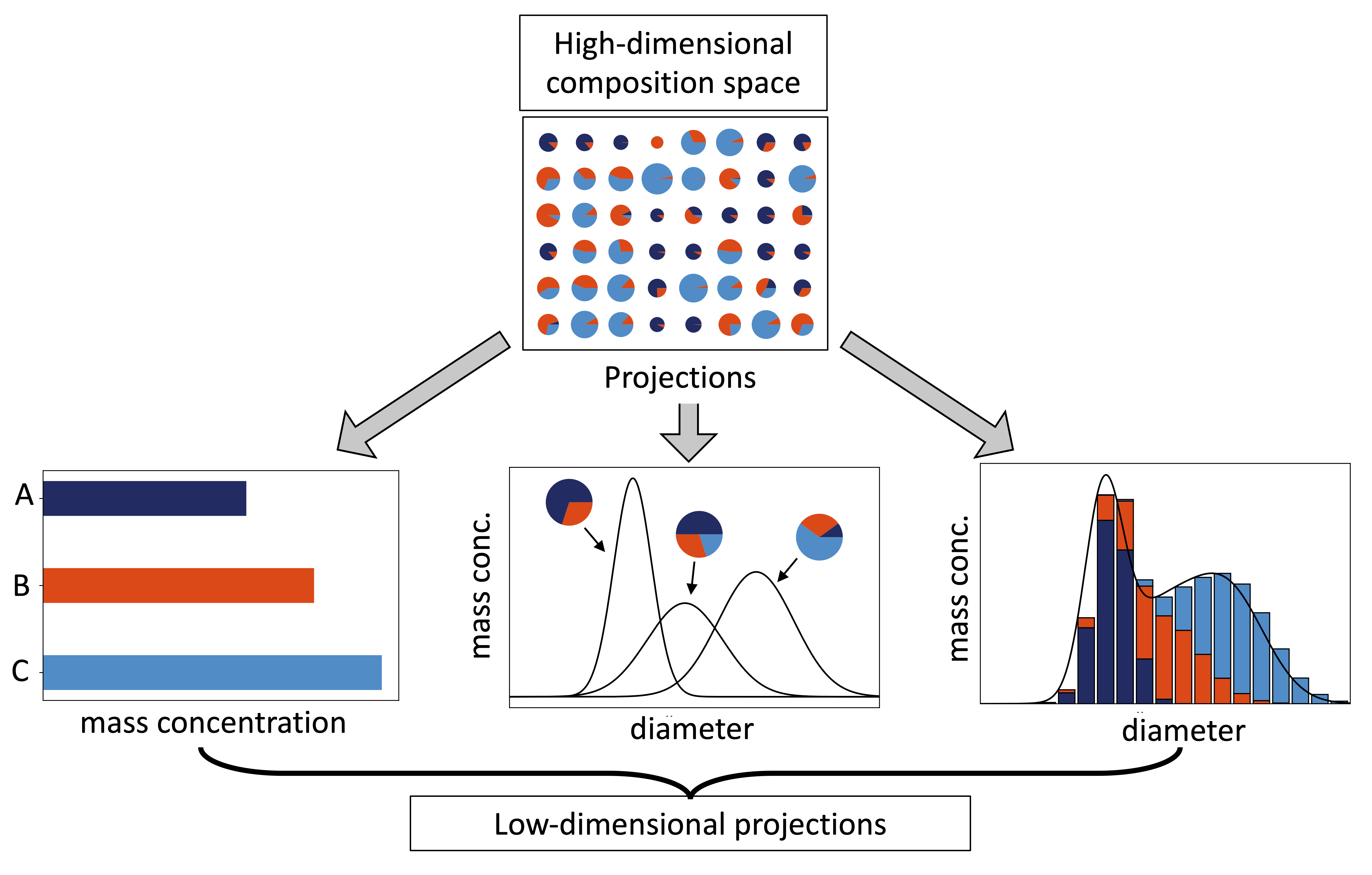
Illustration of three different ways the true (high-dimensional) composition space can be collapsed into low-dimensional projections, for bulk, modal, and sectional model representations. Image from journal.