

New parameterizations to connect aerosol phase state with their ice nucleation abilities
Submitter
Zhang, Yue — Texas A&M University
Area of research
Aerosol Processes
Journal Reference
Science
We combined laboratory experiments, modeling, and field data to demonstrate that organic aerosols may significantly contribute to the formation of ice clouds in certain atmospheric regions.
Impact
Such results can be used for regional and global Earth forecasting models to help improve the predictability of cloud formation, cloud properties, and the Earth's atmosphere.
Summary
The results used laboratory data with semi-empirical parameterizations to establish the connection between the ice nucleation properties of organic aerosols and their phase state. By using the DOE GoAmazon field data, we have shown that organic aerosols, such as those formed from isoprene, can contribute significantly to the ice nucleation particles in the upper tropospheric region above the Amazon forest. This work highlights the need to incorporate such parameterizations in Earth predictability models to improve simulations of ice clouds.
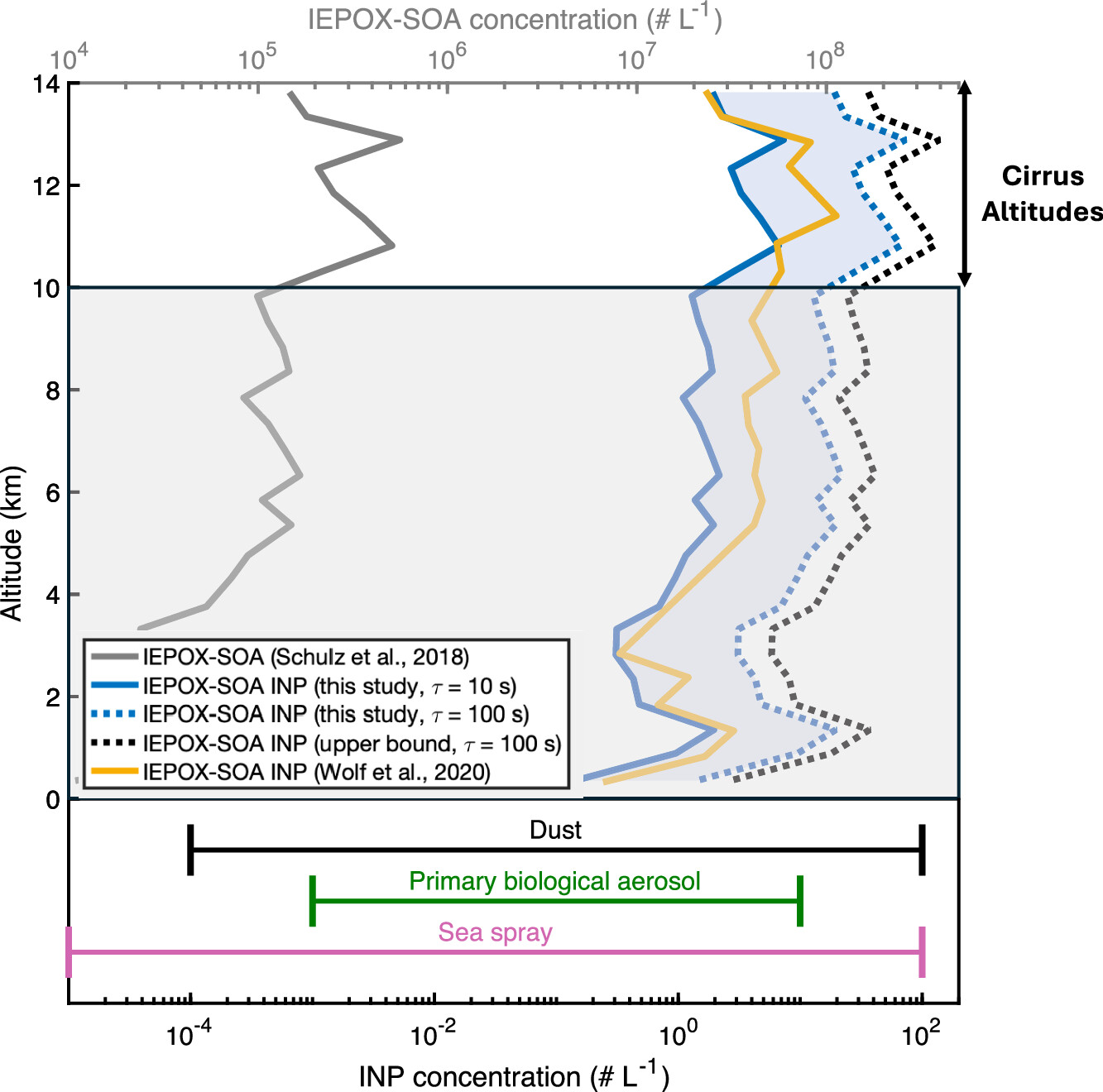
This image uses field data, lab experiments, and modeling to jointly demonstrate that the amount of the ice nucleation particles from organic aerosols are significant in the upper tropospheric region above the Amazon rainforest, highlighting that organic aerosols may be important ice nucleation particles due to the change of their phase state.
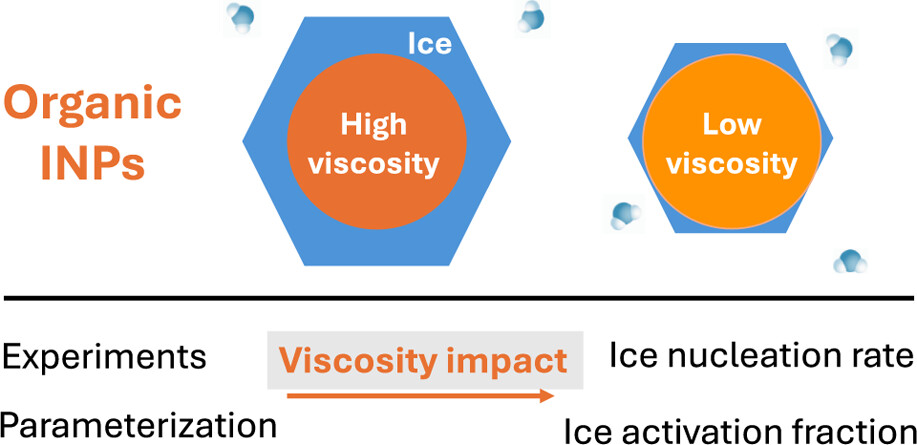
This is a schematic image showing organic aerosols can contribute significantly to ice nucleation due to changes in their phase state.