
A New Theory of Time-Dependent Freezing and Its Application to Investigation of Formation of Hail
Submitter
Khain, Alexander — The Hebrew University of Jerusalem
Phillips, Vaughan — Lund University
Area of research
Cloud Processes
Journal Reference
Science
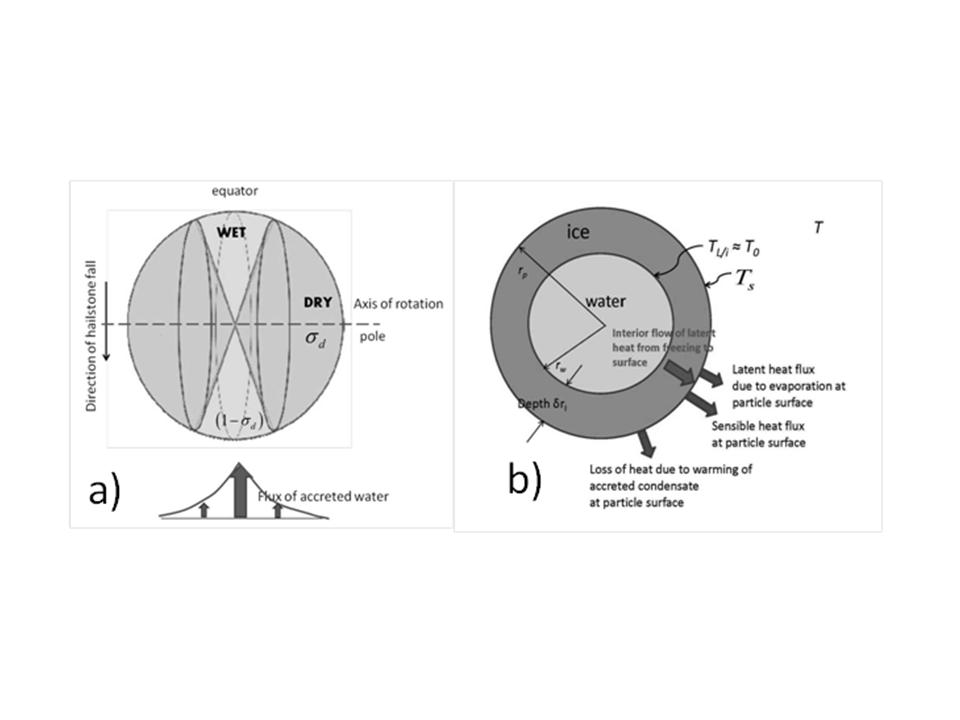
A new theory of wet growth of hail takes into account the inhomogeneities of surface temperature and of liquid film over the surface of the particle and parameterizes effects of non-sphericity of hail particles on their growth by accretion (Figure 1a). The time-dependent process of raindrop freezing as well as freezing of accreted water by graupel and hail is described in the most general form, including the thermodynamic effects of accreted water as well as ice crystals. Freezing drops (FDs) are assumed to consist of interior water covered by ice (Figure 1b).
Impact
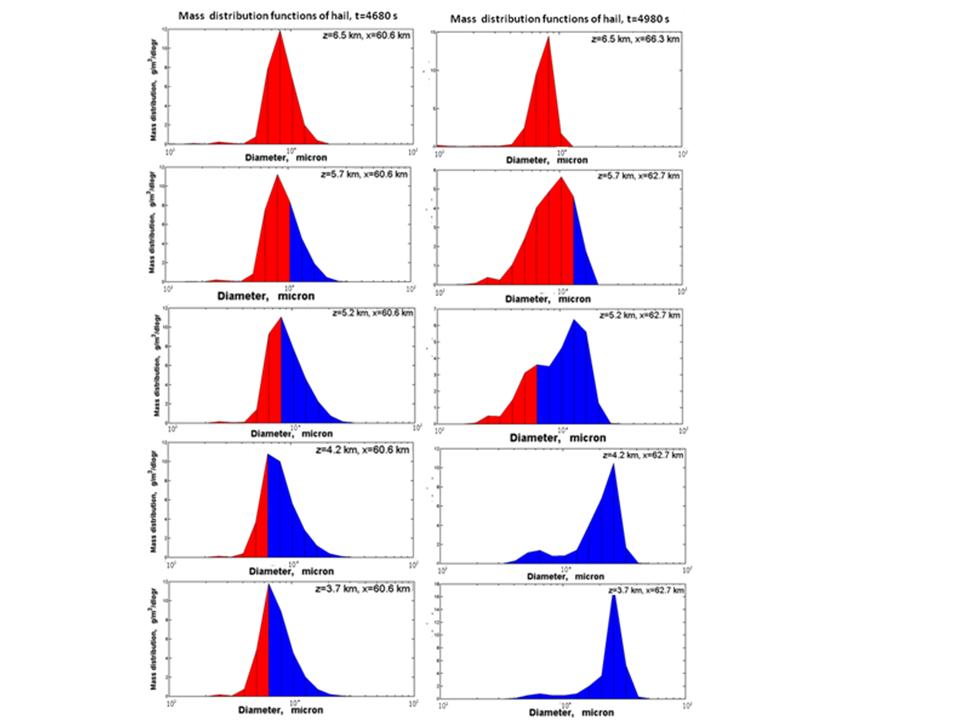
A hail storm typical of Oklahoma was simulated using the Hebrew University Cloud Model (HUCM). The model predicts that accretion of liquid produces giant FDs of 0.5-2 cm in diameter, which significantly exceeds the size of purely liquid drops. The FDs are predicted to be in wet growth with accreted liquid remaining unfrozen, which temporarily stops their internal freezing while they continue to grow. The maximum diameter of hailstones simulated by the HUCM was about 5 cm in agreement with observations. Large FDs and hailstones are formed in the course of the recirculation from the downdraft back into the updraft where the particles growth by accretion of a supercooled cloud droplets, which increases their amount in polluted air. Large hail does not form in clouds developing in clean air. Figure 2 shows hail mass distributions at different heights at the development (left column) and decaying stages (right column) of a deep convective cell. The size distributions of hail and liquid water content are plotted for the atmospheric columns in which the mass content was a maximum. The size ranges corresponding to the dry and wet growth regimes are displayed in different colors. In strong updrafts, smaller hailstones grow by dry growth, while larger hailstones are in wet growth regime. The size separating particles in wet and dry growth, Donset, is about 1 cm. Due to the larger size of hail during the decaying stage decreases downward and below 4.2 km all hail particles are in the wet growth regime.
Summary
The theory explains the laboratory experiments, some of which we simulated off-line. The schemes of time-dependent freezing for rain and wet growth of hail and graupel were implemented into the HUCM with a spectral bin microphysics.
It was shown that large hail forms in clouds developing in pollutant air by accretion of a high mass of supercooled droplets in the course of hail recirculation within the updraft area. Hail in clean air forms by raindrop freezing. In clouds developing in clean air, hail size is much lower and hail melts not reaching the surface.