

Understanding factors promoting development of deep cumulus clouds
Submitter
Morrison, Hugh Clifton — University Corporation for Atmospheric Research
Area of research
Cloud Processes
Journal Reference
Science
The initiation of deep cumulus clouds is a key for weather and climate. It is well known that an atmosphere that is conditionally unstable and can support the lifting of air parcels to their level of moist convective instability are necessary for the development of deep cumulus clouds. However, even when these conditions are met, deep cumulus often do not occur. In this study, we examined additional factors controlling the initiation of deep cumulus.
Impact
This study used detailed modeling and theory to analyze two key factors impacting the initiation of deep cumulus clouds: the relative humidity of the environment between clouds, and the horizontal scale of ascent below cloud base driven by surface flux forcing. In the model simulations, the transition from shallow to deep cumulus occurred with only small increases in horizontal scale of surface-driven low-level ascent less than 300-400 meters, all else being nearly equal. Drier environments required wider regions of forcing for deep cumulus clouds to develop. The impacts of these factors in controlling whether cumulus clouds stayed shallow or grew deep was encapsulated by a simple mathematical formula. Overall, these results suggest that small changes to the horizontal scale of low-level forcing, exerting a dominant control on cloud base width, may be a key regulator of deep convection initiation.
Summary
Using a state-of-the-art modeling tool called large-eddy simulation (LES) that represents details of clouds and air motion and theory, this study investigated two key factors influencing the initiation of deep cumulus clouds: the relative humidity of the environment between clouds, and the horizontal scale of low-level ascent driven by surface flux forcing. Model simulations showed a sharp transition from clouds remaining shallow to quickly growing deep as the horizontal scale of surface flux forcing increased. The forcing width at which this transition to deep convection occurred was strongly dependent on relative humidity of the environment, and also dependent on the rate at which temperature decreased with height in the environment. A wider region of surface flux forcing led to wider clouds, which were required in a drier environment to overcome the effects of entrainment and cloud dilution for clouds to grow deep. Together with theoretical arguments, it was shown that the transition to deep convection could be well described by a simple mathematical relation. This relation states that the ratio of the cloud base area (proportional to the area of low-level forcing) to the saturation deficit (one minus relative humidity of the environment) must exceed a threshold value before cumulus convection transitions to deep. This threshold decreases with a steeper cloud layer environmental lapse rate.
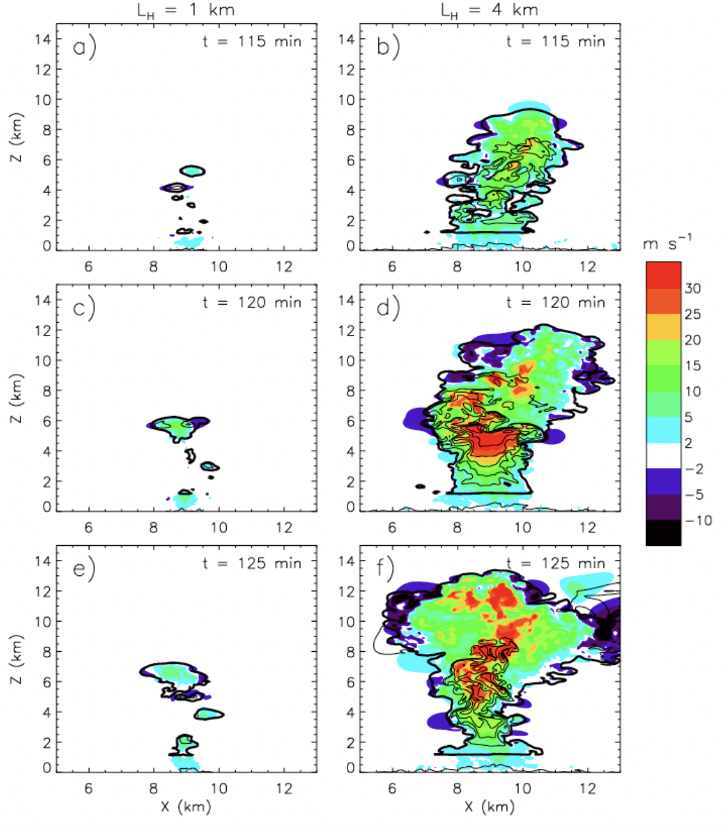
Figure 1. Vertical cross-sections through the cloud center of vertical air velocity (color contours), buoyancy (thin black contour lines, 0.05 m s-2 interval), and cloud outline (thick black lines), at the three times indicated. Left and right panels show results for narrow and wide region of sub-cloud ascent, respectively. From journal.
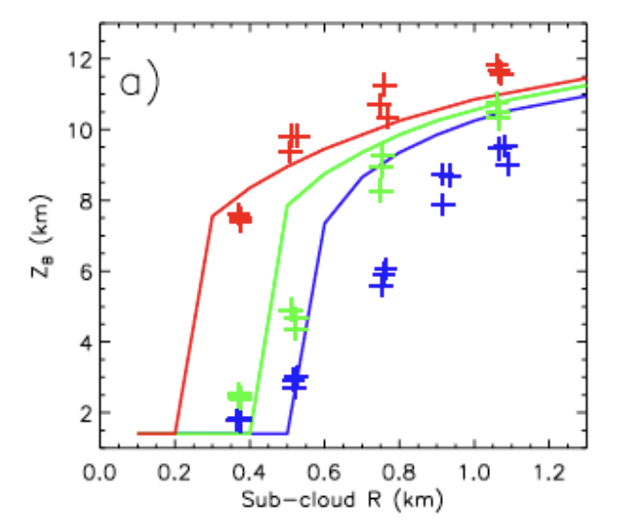
Figure 2. The cloud equilibrium height (highest level of cloudy updraft air that is positively buoyant) on the y-axis versus the horizontal scale of sub-cloud ascending air driven by surface forcing on the a-axis. Cross marks show results from large-eddy simulations, and lines show results using a simple theoretical updraft model. Red, green, and blue lines indicate results for moist (90% relative humidity, RH), moderate (60% RH), and dry (30% RH) free tropospheric environments. From journal.