
Using Doppler Radar to Characterize Cloud Parameters
Submitter
Kogan, Yefim — University of Oklahoma - CIMMS
Area of research
Cloud Distributions/Characterizations
Journal Reference
Kogan, Y.L., Z. N. Kogan, and D. B. Mechem, 2007: Assessing the errors of microphysical retrievals in Marine Stratocumulus based on Doppler radar parameters, J. Hydrometeorol., GEWEX special issue, 8, 665-677.
Science
Marine stratus and stratocumulus clouds play an important role in global water and energy budget by increasing the local planetary albedo by 30-50% while having relatively little impact on outgoing longwave radiation. These clouds are widespread, and at any given time, may cover much of the eastern subtropical Pacific and Atlantic oceans, most of the Arctic Ocean in summer, and large regions of the middle latitudes. The characterization of these cloud parameters using remote sensing instruments, ground- or space-based, is very important and has significantly advanced recently due to the progress in development of the millimeter wavelength cloud radars (MMCRs). Since the late 90s, MMCRs have been in operation at the ARM Climate Research Facility's observational sites and have flown on the National Aeronautics and Space Administration (NASA) CloudSat satellite mission.
Impact
Of special interest to climate modelers are characterization of cloud liquid water and drizzle flux. In this study, we evaluated how the retrieval of these characteristics may be improved by using MMCR parameters, such as radar reflectivity, mean Doppler velocity, and Doppler spectrum width. The evaluation was conducted under the controlled framework of the Observing System Simulation Experiments (OSSEs). Cloud radar parameters are obtained from drop-size distributions generated by the high-resolution large-eddy simulation (LES) model, with detailed formulation of cloud microphysics. This also included prediction of the evolution of drop-size distributions based on the exact, not parameterized, formulation of individual microphysical processes.
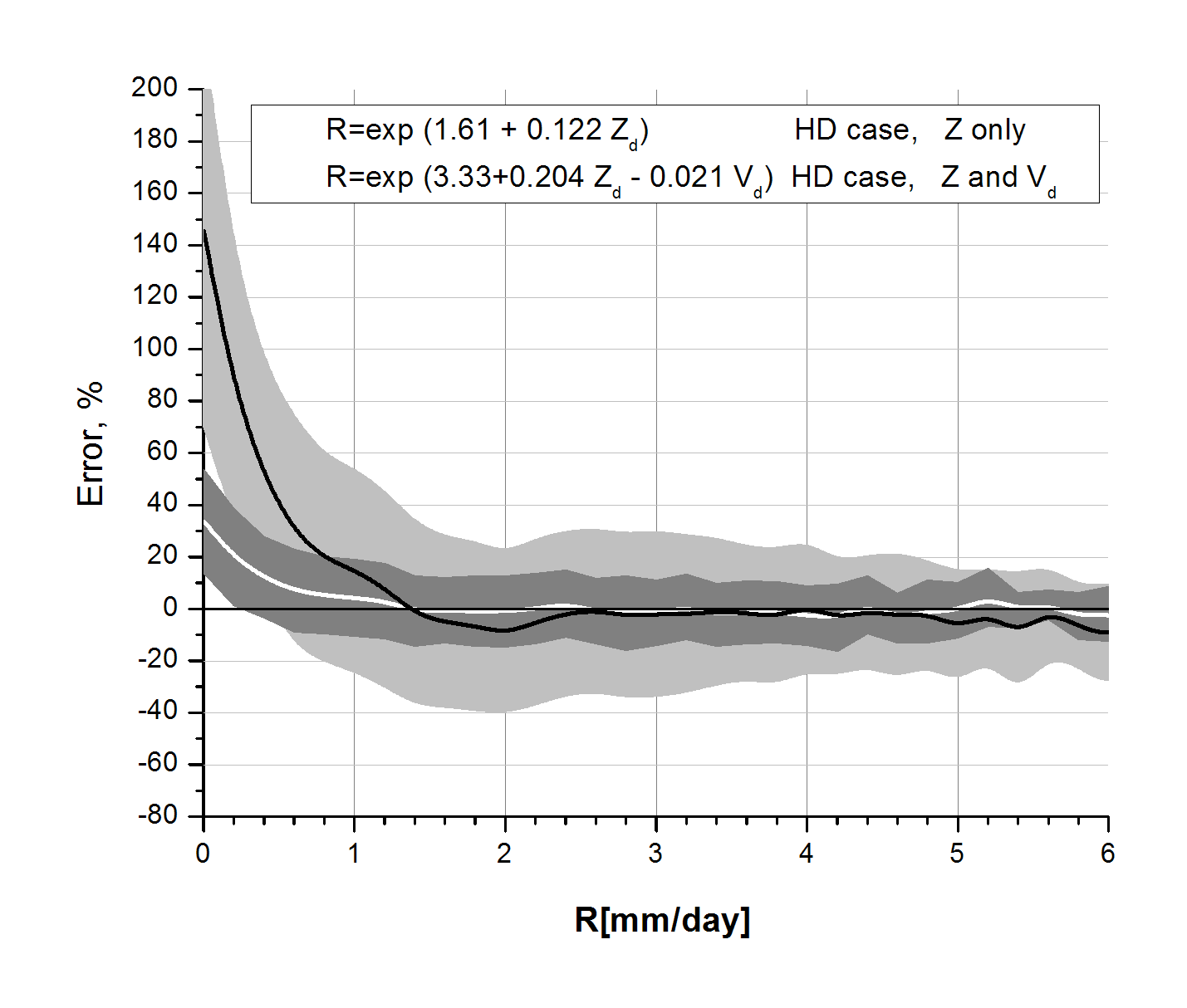
There is significant improvement in retrieval of drizzle flux when mean Doppler velocity is added to the retrieval algorithm compared to the retrieval based on radar reflectivity alone. In the moderate drizzle case the use of a two-parameter retrieval yields a nearly perfect correlation (R2 = 0.997). For the heavy drizzle (see Figure 1 case HD), the correlation coefficient increased from 0.794 for the retrieval based on radar reflectivity alone to 0.962 when the two-parameter retrieval is used.
Summary
It is shown that in drizzling stratocumulus the accuracy of cloud liquid water and drizzle flux retrievals can be substantially increased when information on the mean Doppler velocity or Doppler spectrum width is included in the retrieval algorithm, in addition to radar reflectivity. In the case of moderately drizzling stratocumulus clouds, the mean error in retrieving the liquid water content is of the order of 10%; in the case of heavy drizzling stratocumulus clouds, this value is approximately 20-30%. Similarly, employing Doppler radar parameters significantly improves the accuracy of drizzle flux retrieval. The use of Doppler spectrum width instead of Doppler velocity yields about the same accuracy, thus demonstrating that both Doppler parameters have approximately the same potential for improving microphysical retrievals.