
Cloud-Radiation Effects on Sea Ice Loss
Submitter
Stephens, Graeme L. — Colorado State University
Area of research
Cloud Distributions/Characterizations
Journal Reference
Kay, JE, T L’Ecuyer, A Gettelman, G Stephens, and C O’Dell. "The contribution of cloud and radiation anomalies to the 2007 Arctic sea ice extent minimum." To appear in Geophysical Research Letters.
Science
Passive microwave satellite observations, available from 1979 to present, show declines in Arctic sea ice extent. Downward trends, while present in all months, are largest in September when the ice reaches its annual minimum extent. While the downward trend in the minimum ice extent has substantial inter-annual variability, the 2007 minimum extent represents a dramatic departure from the historical trend line. The 2007 minimum extent was 4.13 million km2 on September 16, 2007, down 43% from 1979 and down 22% from the previous record in 2005. During 2007, large negative anomalies in ice extent persisted from July through early September, mostly in the Pacific sector of the Arctic.
Impact
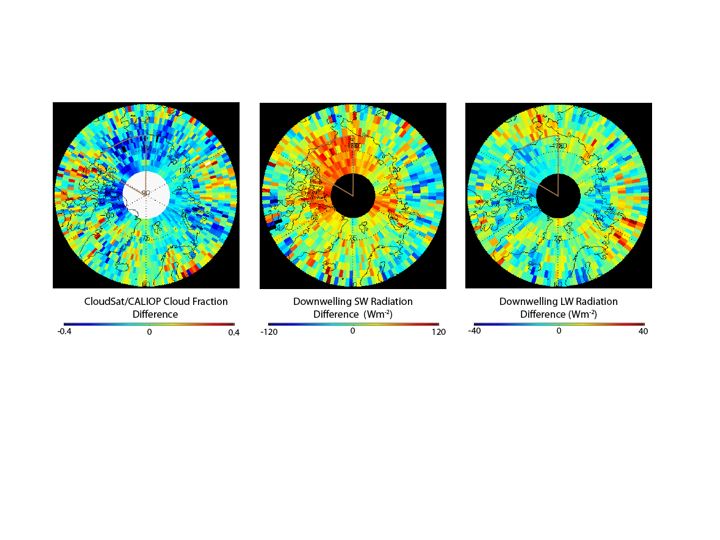
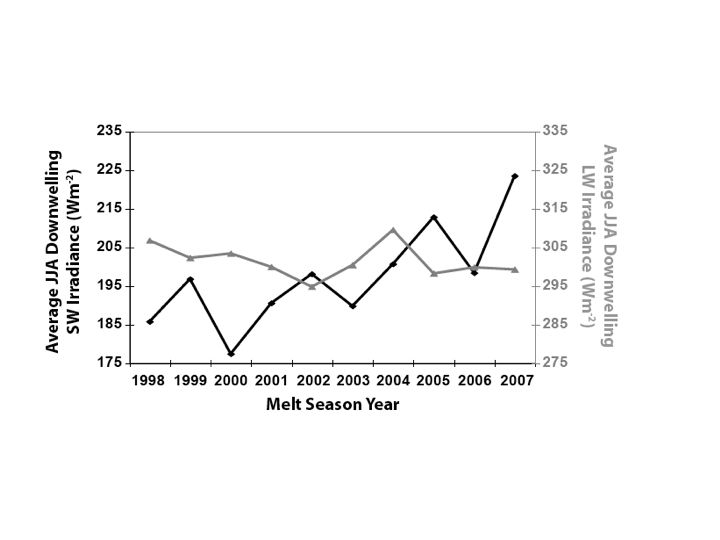
Reduced cloudiness and enhanced downwelling radiation are associated with the unprecedented 2007 Arctic sea ice loss. Over the Western Arctic Ocean, total summertime cloud cover estimated from spaceborne radar and lidar data decreased by 16% from 2006 to 2007. The clearer skies led to downwelling shortwave (longwave) radiative fluxes with increases of +32 Wm-2 (- 4 Wm-2) from 2006 to 2007. Over three months, simple calculations show that these radiation differences alone could enhance surface ice melt by 0.3 m, or warm the surface ocean by 2.4 K, which enhances basal ice melt. Increased air temperatures and decreased relative humidity associated with an anti-cyclonic atmospheric circulation pattern explain the reduced cloudiness. Longer-term observations show that the 2007 cloudiness is anomalous in the recent past, but is not unprecedented. Thus, in a warmer world with thinner ice, natural summertime circulation and cloud variability is an increasingly important control on sea ice extent minima.
Summary
Satellite and ground-ba